Biofuel Production and Improving Water Quality

Learn which biofuels require less inputs and strategies to reduce pollution.

Nitrates are most frequently detected in groundwater where nitrogen fertilizer is most heavily used; but exceptions to this pattern occur. USGS image.

Table Of Contents

Water Quality

Biofuel crops can help improve water quality because some need less fertilizer, are perennials, and have a more closed canopy. In order for production of agricultural energy crops to be considered sustainable, practices must be in …

Gauging Farm Energy Sustainability – Table of Contents

Articles

How Sustainable are Your Farm Energy Systems?

Learn about sustainability indicators used to gauge and evaluate a farm’s progress toward energy sustainability.

Solar installation at Harlow Farm, Westminster, VT. Photo: Susan Harlow

Table of Contents

What Is a Sustainability Indicator?

Sustainability indicators are measurable or observable features that can be used to test principles and criteria of sustainability. Sustainability indicators could include quantifiable measures of resource use efficiency, energy, food security, land use impacts

Maximizing Planted Area and Biomass Production in Shrub Willow Bioenergy Fields

Willow Stand Density biomass
Willow stand density. Photo: SUNY-ESF.
A portion of the land area in commercial willow bioenergy fields must be left unplanted for headlands to facilitate efficient machinery operation. Other unplanted areas, if not functional, should be minimized through best-practice targets in order to maximize biomass production and revenues.


Table of Contents

Introduction

An important consideration for commercial shrub willow crop …

EcoWillow 2.0: An Updated Tool for Financial Analysis of Willow Biomass

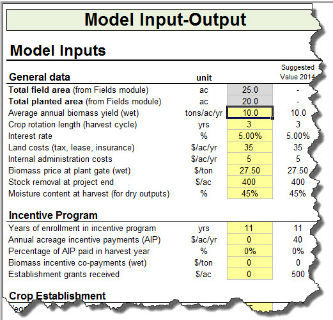
Model input output


EcoWillow is a financial analysis tool developed by SUNY-ESF that allows users to model the costs and revenues of willow biomass production through every stage of the feedstock life cycle from site preparation through planting, harvesting, and transport to an end user for renewable energy

Table of Contents

double row planter willow
Figure 1. Planting a willow crop in northern New York State using

Current USDA NIFA AFRI CAPs

USDA-NIFA (National Institute for Food and Agriculture) currently funds 7 bioenergy Coordinated Agricultural Projects (CAPs) through Agricultural and Food Research Initiative (AFRI) Grants. 

AFRI CAPs 2015
AFRI CAP Biofuel Feedstocks and Project Locations

Explore the NIFA Bioenergy CAPs:


Advanced Hardwood Biofuels Northwest (AHB)
Lead Institute:  University of Washington
Awarded:  2011
Feedstock:  Purpose grown woody crops (e.g. poplar)
Conversion platform target: Hybrid bio/thermochemical conversion
Industrial Partners: ZeaChem Inc.


Northwest Advanced Renewables Alliance (NARA)
Lead Institute:  Washington State University
Awarded:  2011
Feedstock: Forestry residuals
Conversion

Wind Power On Farms

Farm Energy IQ logo


Is wind energy a viable option for your home or business to lower reliance on the grid supplied electricity?  In this module, learn how to gauge your the wind resource where you live and calculate the likely annual electricity production.

Link to all of the Northeast Farm Energy IQ Curriculum, developed by Extension specialists from Penn State, Rutgers and University of Vermont.

This is part of the On Farm Energy Production Curriculum Series: 

Bioenergy Feedstock Production | Biodiesel and

Solar Electric and Solar Thermal

Farm Energy IQ logo


This solar electricity and solar thermal module provides a basic understanding and how to calculate a simple payback term for the installation of different size systems. Learn about programs that may be available to subsidize your investment.

Link to all of the Northeast Farm Energy IQ Curriculum, developed by Extension specialists from Penn State, Rutgers and University of Vermont.

This is part of the On-Farm Energy Production Curriculum Series: 

Bioenergy Feedstock Production | Biodiesel and SVO | Biogas | …

Energy Efficiency for Direct Market Farms

Farm Energy IQ logo


This curriculum module on Energy Efficiency for Direct Market Farms the fundamentals of energy systems.  Topics include basic thermodynamics, heat transfer, energy conversion processes and discussion of energy efficiency and specific applications on farms.

Link to all of the Northeast Farm Energy IQ Curriculum, developed by Extension specialists from Penn State, Rutgers and University of Vermont.

This is part of the Farm Energy Efficiency (EE) Curriculum Series:  Farm Energy Efficiency Principles | Energy Audits | EE for Dairy Farms